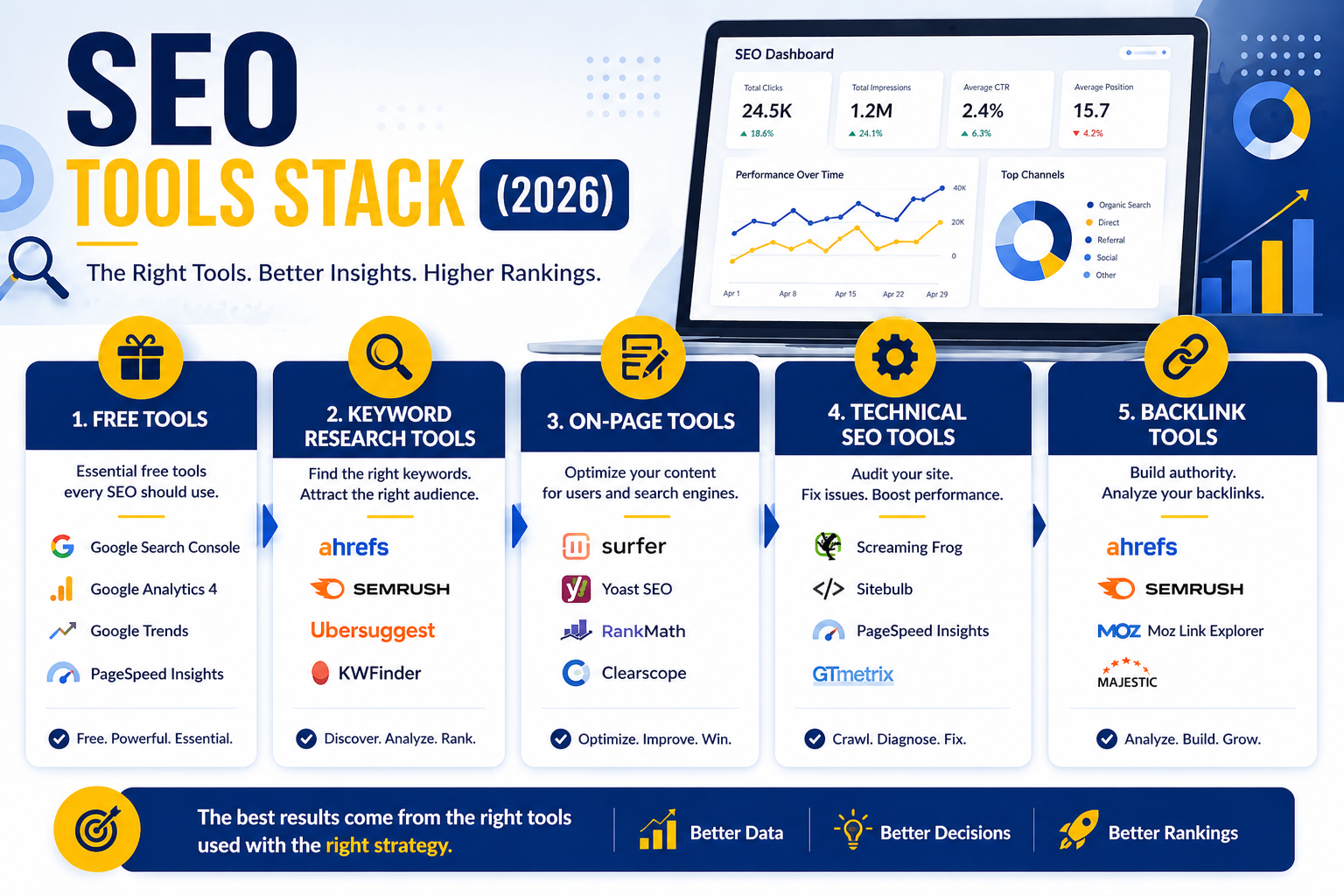
Best SEO Tools 2026
There’s no shortage of SEO tools.
In fact, that’s the problem.
Most people don’t struggle because they lack tools—
they struggle because they use too many tools without a clear purpose.
In 2026, you don’t need a complex stack.
You need a small set of tools that help you make better decisions.
This guide breaks down the most useful SEO tools by function, so you know exactly what to use—and what to ignore.
1. Start with the Best SEO tools basics (Free Tools First)
Before paying for anything, get this right:
Essential free tools:
- Google Search Console
- Track performance
- Identify keywords
- Monitor indexing
- Google Analytics
- Understand user behavior
- Track traffic sources
These two alone can take you surprisingly far
2. Keyword Research Tools
These help you discover and evaluate keyword opportunities.
What to look for:
- Keyword ideas
- Search volume
- Difficulty estimates
Popular options:
- Ahrefs
- SEMrush
- Ubersuggest
Honest take:
Most tools give similar data.
The value comes from how you interpret it.
Don’t overthink tool choice—focus on usage
3. On-Page SEO best SEO Tools
These help optimize your content structure and readability.
What they do:
- Suggest improvements
- Analyze keyword usage
- Highlight gaps
Examples:
- Surfer SEO
- Yoast SEO (for WordPress)
Use these as guides—not strict rules
4. Technical SEO Tools
Useful for identifying site-level issues.
What to check:
- Broken links
- Site speed
- Crawl issues
Examples:
- Screaming Frog
- PageSpeed Insights
Most sites don’t need deep technical analysis—just the basics
5. Backlink Analysis Tools
Used to evaluate authority and link profiles.
What they show:
- Who is linking to you
- Competitor backlinks
- Link quality
Examples:
- Ahrefs
- SEMrush
Important—but not your starting point
6. Rank Tracking Tools
These help monitor keyword positions over time.
Use them to:
- Track progress
- Identify trends
But don’t obsess over daily rankings
Focus on overall growth
7. All-in-One vs Specialized Tools
You’ll notice most tools overlap.
Two approaches:
All-in-one tools
- Convenient
- Everything in one place
Specialized tools
- More focused
- Sometimes better at specific tasks
Choose based on:
- Your workflow
- Not features alone
8. What Most People Get Wrong About SEO Tools
Let’s be direct here:
- Tools don’t create strategy
- Tools don’t improve content
- Tools don’t guarantee rankings
They only support decisions
The real difference comes from:
- Understanding intent
- Creating useful content
- Consistent execution
9. Simple SEO Tool Stack (Recommended)
If you want to keep things clean:
Starter setup:
- Google Search Console
- Google Analytics
Add one paid tool (optional):
- Ahrefs OR SEMrush
That’s enough for most websites
10. FAQs
Do I need paid SEO tools?
No. You can start with free tools and upgrade later.
Which SEO tool is the best?
There’s no single best tool—choose based on your needs.
How many tools should I use?
As few as possible while still getting clarity.
Conclusion
SEO tools are useful—but they’re not the advantage.
The advantage comes from:
- Clear thinking
- Structured execution
- Consistency over time
Use tools to support that—not replace it.
Before using more SEO tools, get your basics clear.
SEO tools are useful, but they work best when you know what you are trying to improve.
The First-Time SEO Starter Kit helps you understand your website, choose your first keywords, and improve one page before getting lost in too many tools.
📘 Read SEO Best Practices 2026
🔍 Learn Keyword Research 2026
⚙️ Follow the On-Page SEO Checklist