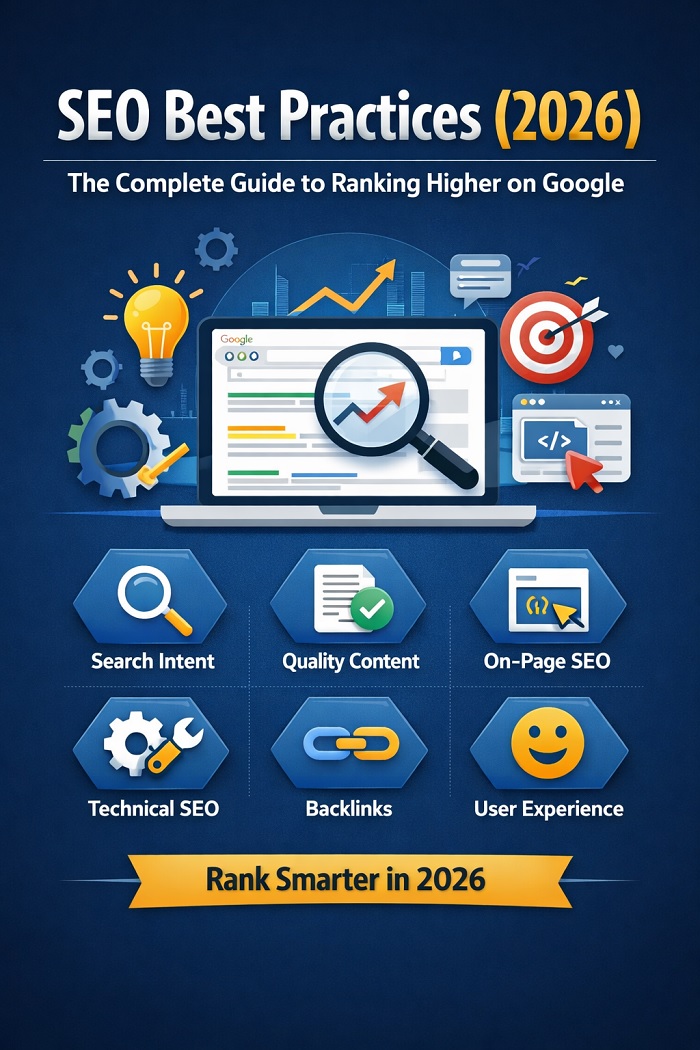
Introduction: What Matters for SEO in 2026?
SEO hasn’t become harder—it has become less forgiving.
What worked earlier—adding more keywords, publishing more content, building more backlinks—no longer guarantees results.
Today, Search Engines such as Google reward something much simpler (and much harder to execute consistently):
Content that genuinely satisfies user intent and builds trust over time
If your pages don’t meet those needs, optimisation alone is unlikely to make them successful in search results.
This guide explores practical SEO principles that can improve your website’s usefulness and search visibility in 2026, with an emphasis on approaches that remain relevant as search engines evolve.
Where Should a Small Website Start with SEO?
If you’re managing a small website, you probably don’t have the time or resources to optimise everything at once.
The useful question isn’t necessarily, “How do I improve my entire website?” It’s “Which improvement would make the greatest difference to someone visiting my site?”
Imagine you have a website with ten pages. Some explain your services, others answer common questions, and a few receive occasional search impressions.
Here’s a practical way to begin:
- Choose one important page. Look for a page that answers a useful question or supports an important business goal.
- Understand what visitors are searching for. Use Google Search Console to identify relevant queries and check whether the page answers them.
- Review the page’s title and content. Make sure visitors can quickly understand what the page offers and find the information they need.
- Check internal links. Link to the page from other relevant content using descriptive anchor text.
- Measure what happens. Record impressions, clicks and average position, then compare performance over time.
You don’t need to change every page simultaneously. Starting with one page allows you to understand what needs improving, make a thoughtful change and observe what happens.
But before making any changes, there’s one important question to consider: What is the person searching for, and does your page meet that need?
1. Start with Search Intent (Not Keywords)
An SEO strategy can lose direction when it focuses on keywords without considering search intent.
Search intent is the why behind a query.
And Google has become extremely good at identifying it.
The 4 main types of search intent:
- Informational – Learning something or finding an answer.
- Navigational – Finding a specific website or page.
- Commercial investigation – Comparing products, services or options before making a decision.
- Transactional – Ready to take an action, such as making a purchase.
What most people get wrong:
They target the right keyword—but deliver the wrong format.
For example:
- Searching “best SEO tools” → expects a comparison list
- Searching “what is SEO” → expects a simple explanation
When a page doesn’t match what someone is looking for, it may struggle to compete in search results—even when its keywords are relevant.
Practical rule:
Before creating content, study the top results and align with:
- Format
- Depth
- Angle
SEO starts with alignment—not optimization.
Once you understand what someone is looking for, the next question is whether your content genuinely helps them find it.
2. Create Content That Actually Deserves to Rank
There is no shortage of content on the internet. But publishing something new doesn’t necessarily mean adding something useful.
Search engines aim to help people find relevant, helpful information.
So perhaps the question isn’t only:
“Is your content optimized?”
But also:
“Is your content genuinely useful to someone searching for this information?”
What useful content does:
- Answers the question clearly.
- Removes confusion rather than adding to it.
- Uses structure and examples to guide the reader.
- Provides practical information rather than generic advice.
What to avoid:
- Writing simply to meet a word count.
- Repeating what already exists without adding value.
- Adding surface-level information that leaves questions unanswered.
A better standard:
Your goal isn’t necessarily to write more. It’s to create a page that answers the reader’s question well.
Once the content itself is useful, clear titles, headings and internal links can make it easier for people to find and understand that information.
3. Get the On-Page SEO Fundamentals Right (Without Overdoing It)
On-page SEO still matters. Clear titles, headings and internal links help readers and search engines understand your content. But optimisation alone cannot compensate for content that doesn’t meet the reader’s needs.
Focus on getting these right:
Title Tag
- Describe the page clearly and accurately.
- Include relevant search terms naturally, without forcing them.
- Summarise what the page offers.
- Help readers decide whether it’s relevant to their search. Google may generate a different snippet from the page content.
Headers (H1, H2, H3)
- Organise content into logical sections.
- Make information easier to scan and understand.
Internal Linking
- Connect related pages using descriptive link text.
- Help readers discover useful information and search engines understand relationships between pages.
Where people go wrong:
- Repeating keywords unnecessarily.
- Writing primarily for search engines rather than readers.
- Treating on-page optimisation as a substitute for useful content.
Simple principle: Clarity beats excessive optimisation.
For a more detailed explanation, explore our On-Page SEO Best Practices guide.
4. Technical SEO: Get the Foundations Right
Technical SEO helps search engines discover, crawl and understand your website. Even useful content may struggle to appear in search results if important technical issues prevent it from being accessed or indexed.
What actually matters:
- Crawlability and indexing: Make sure important pages are accessible to search engines and eligible for indexing.
- Mobile usability: Ensure your website works well across different devices.
- Page performance: Keep pages reasonably fast and responsive.
- Website structure: Use clear navigation, working internal links and appropriate canonical URLs.
You don’t need to chase every recommendation from an SEO audit tool. Prioritise issues that affect access, usability or the visibility of important pages.
Focus shift: Fix meaningful technical problems, then give equal attention to content quality and search intent. Good SEO needs both.
5. Build Authority Through Backlinks (The Right Way)
Backlinks—links from other websites to yours—can help search engines discover content and understand its relevance. But not every backlink carries the same value.
What works:
- Earning links from relevant, credible websites.
- Creating useful resources that others may want to reference.
- Building genuine relationships and visibility within your field.
What to avoid:
- Buying links intended to manipulate search rankings.
- Participating in excessive link exchanges or automated link schemes.
- Pursuing large numbers of low-quality links simply to increase backlink counts.
A better approach:
Think about what would make someone genuinely want to reference your content. It might be a helpful explanation, an original observation, a practical checklist or a resource that solves a specific problem.
Backlinks are most valuable when they arise naturally from the usefulness and relevance of your work.
To understand the broader idea of website credibility, read our guide to authoritative websites.
6. Optimise for Users, Not Just Search Engines
A good user experience helps visitors find and understand the information they need.
Clear formatting, useful content and straightforward navigation make a page easier to use. And sometimes, a visitor may find their answer quickly and leave satisfied. That doesn’t necessarily indicate a poor experience.
Focus on:
- Clean, readable formatting.
- A logical flow of information.
- Clear sections and descriptive headings.
- Navigation and links that help visitors find related information.
- Content that answers the question without unnecessary distractions.
What this really means:
SEO isn’t simply about attracting visitors. It’s about helping them find what they came for, whether that takes thirty seconds or several minutes.
Rather than focusing only on how long someone stays on a page, consider whether the page makes their next step clear and useful.
For more on creating helpful navigation and links, explore our guide to linking for users.
7. Build Topical Depth, Not Just Individual Pages
A useful article can answer one question. But readers often have related questions, and a well-organised website can help them explore those connections.
This is where thoughtful content planning and internal linking become valuable.
What works:
- Covering related questions with useful, focused content.
- Giving each important page a clear purpose.
- Connecting relevant pages through descriptive internal links.
- Improving existing content rather than creating another page that serves the same purpose.
For example, someone learning about keyword research may naturally want to understand how to use those keywords in page titles, headings and content.
Rather than repeating everything in one article, you can connect the reader to relevant resources that explore each subject in greater detail.
The goal isn’t to publish more pages simply to cover a topic. It’s to make the information you already provide easier to discover, understand and use.
A collection of useful, connected pages can also help search engines understand how related content fits together, although internal linking alone doesn’t establish authority or guarantee rankings.
If you’d like to explore how this works in practice, our SEO Academy includes lessons on website structure, page purpose and internal linking.
8. Avoid These Common SEO Mistakes
Sometimes, the biggest obstacle to improving a website isn’t a lack of SEO knowledge. It’s overlooking the fundamentals while searching for the next technique.
Watch out for:
- Ignoring search intent: Attracting visitors whose questions your content doesn’t answer.
- Publishing rushed content: Adding pages without considering whether they offer something useful.
- Chasing traffic volume: Targeting popular keywords that may bring few relevant visitors.
- Neglecting existing pages: Creating new content while older, useful pages need attention.
- Overlooking measurement: Making changes without checking whether they help.
Before creating another article, look at what you already have. Could a clearer explanation, an updated example or a useful internal link make an existing page more valuable?
Sometimes, the next SEO improvement is already sitting on your website.
9. Frequently Asked Questions
How long does SEO take to show results?
Some changes may become visible within weeks, while others can take several months. The timeframe depends on the website, competition, type of improvement and how search engines process the changes. Better rankings or traffic are never guaranteed.
Is SEO still relevant in 2026?
Yes. People continue to use search engines to find answers, compare options and discover websites. While search experiences are evolving, making content accessible, relevant and useful remains important.
Do I need expensive SEO tools to succeed?
No. Free resources such as Google Search Console can help you understand how your website appears in search results. Paid tools may provide additional insights, but they’re not a prerequisite for making meaningful improvements.
Conclusion: Focus on What Matters
Good SEO isn’t about making every possible change. It’s about understanding which improvements matter most to your website and the people who visit it.
Start with search intent. Create content that answers real questions. Make your pages easy to navigate, address technical issues when they arise, and observe what happens over time.
Not every improvement will produce higher rankings. Some may simply make your website clearer, more useful or easier to navigate. Those improvements have value too.
For a small website, progress often begins with a simple decision: improve what matters before adding something new.
Continue Your Learning
If you’d like to explore these ideas further, our SEO Academy offers structured lessons on SEO fundamentals and website organisation.
You may also find these resources useful: