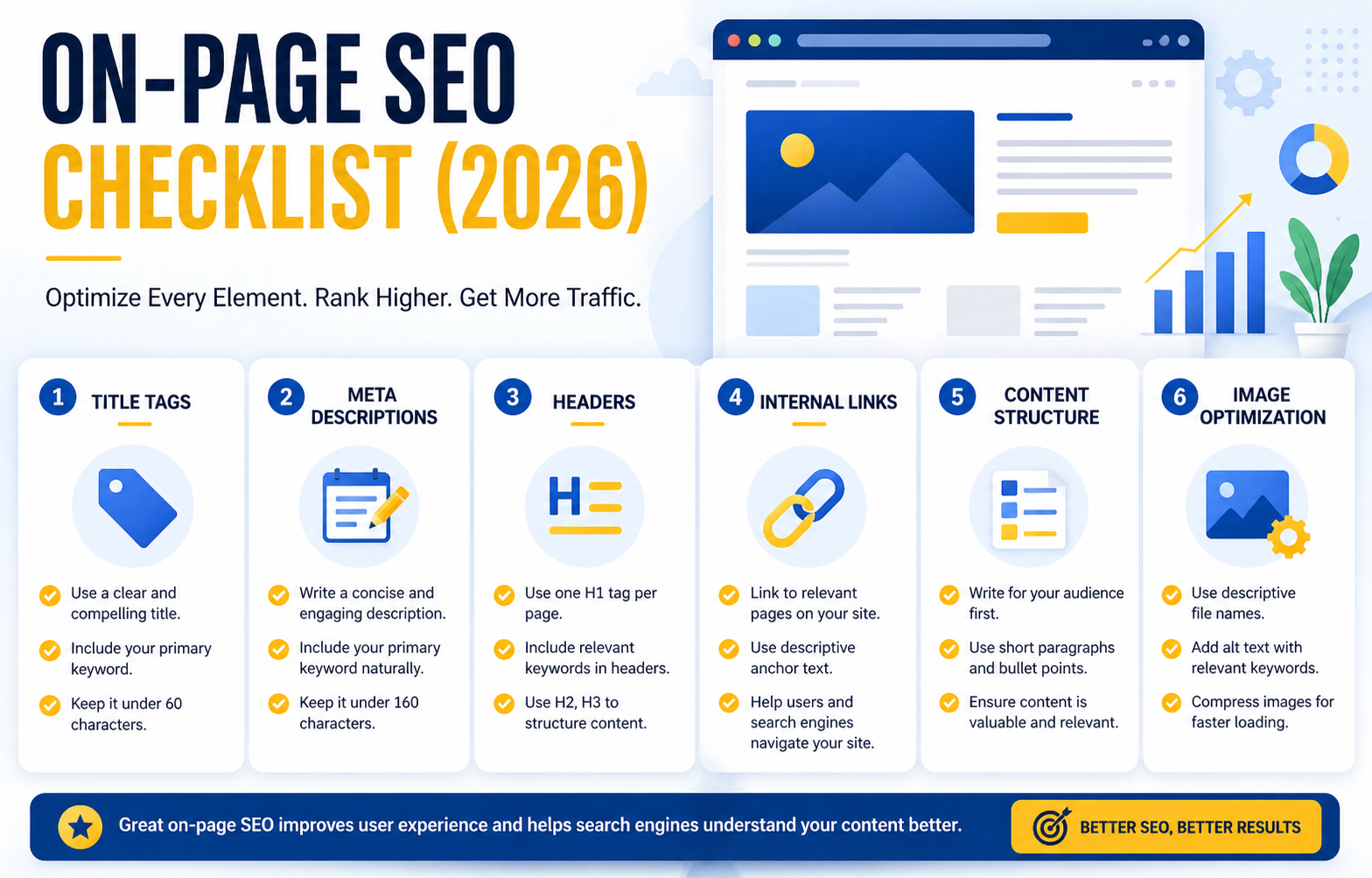
On-Page SEO 2026
On-page SEO hasn’t disappeared—it has simply become more disciplined in 2026.
Most pages don’t fail because they lack optimization.
They fail because they are unclear, unfocused, or misaligned with intent.
In 2026, on-page SEO is no longer about adding keywords everywhere.
It’s about making your page easy to understand—for both users and search engines.
This guide breaks down what actually matters, so you can optimize your pages without overcomplicating the process.
1. Start with a Clear Page Purpose
Before optimizing anything, answer one question:
What is this page supposed to do?
- Educate?
- Compare?
- Convert?
If the purpose is unclear, no amount of optimization will fix it.
What strong pages do:
- Focus on one primary intent
- Avoid trying to do everything at once
Clarity beats coverage
2. Optimize Your Title Tag (Without Overthinking It)
Your title tag is still one of the most important on-page signals.
What works:
- Include your main keyword
- Keep it clear and direct
- Match search intent
What doesn’t:
- Overly clever titles
- Keyword stuffing
- Misleading headlines
Rule: If your title doesn’t clearly describe the page, it won’t perform.
3. Write Meta Descriptions That Earn Clicks
Meta descriptions don’t directly impact rankings—but they impact click-through rate, which does.
Focus on:
- Clear summary of the page
- Simple, benefit-driven language
Think:
“Why should someone click this result?”
4. Structure Your Content with Headers (H1, H2, H3)
Good structure is one of the most underrated SEO advantages.
Why it matters:
- Helps users scan
- Helps search engines understand content
Best practices:
- One clear H1
- Logical H2 sections
- Supporting H3s where needed
If your content looks messy, it performs poorly.
5. Align Content with Search Intent
This is where most pages fail.
You might have:
- The right keyword
- Decent content
But still not rank—because the format doesn’t match intent.
Example:
- “Best SEO tools” → list + comparison
- “What is on-page SEO” → explanation
Optimization starts with alignment—not keywords
6. Use Internal Linking Strategically
Internal links are one of the easiest wins in SEO.
What they do:
- Help search engines discover pages
- Build topical authority
- Improve user navigation
What to do:
- Link to relevant articles
- Use natural anchor text
Every page should connect to your broader content system
7. Optimize for Readability (This Is Bigger Than You Think)
Google increasingly values how users interact with your content.
If users leave quickly, rankings drop.
Improve readability:
- Short paragraphs
- Clear headings
- Bullet points where needed
- Simple language
If your content is hard to read, it won’t rank—even if it’s correct.
8. Optimize Images (Simple but Often Ignored)
Images help both UX and SEO.
Basic optimizations for on-page SEO in 2026:
- Use descriptive file names
- Add alt text
- Compress images for speed
Small improvements here can make a noticeable difference
9. Avoid Common On-Page SEO Mistakes
Most issues come from overdoing things.
Watch out for:
- Keyword stuffing
- Over-optimization
- Writing for bots instead of humans
- Ignoring structure
Good SEO feels natural—not forced.
10. FAQs
What is on-page SEO?
It refers to optimizing elements within your website to improve rankings.
Is on-page SEO still important in 2026?
Yes—but it works best when combined with strong content and intent alignment.
How many keywords should I use?
Focus on one primary topic and cover it well instead of counting keywords.
Conclusion
On-page SEO is no longer about doing more—it’s about doing things with clarity and intent.
If your page:
- Has a clear purpose
- Is easy to read
- Matches what users are looking for
It will perform.
Not because it’s perfectly optimized—but because it’s aligned and useful.
Want a simple way to improve one page?
On-page SEO becomes easier when you follow a clear checklist.
The First-Time SEO Starter Kit includes an on-page SEO checklist, content improvement prompts, and an internal linking planner to help you optimize one page step by step.
📘 Read SEO Best Practices 2026
🔍 Learn Keyword Research 2026
⚙️ Follow the On-Page SEO Checklist