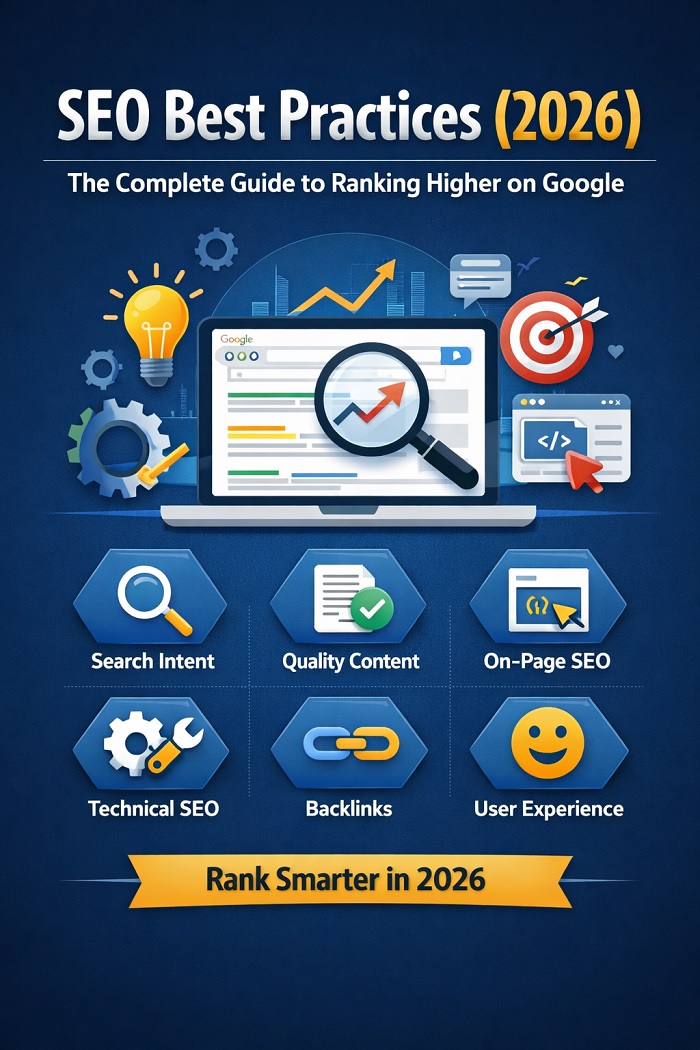
SEO Best Practices (2026): The Complete Guide to Ranking Higher on SERPS
SEO Best Practices 2026- Introduction
SEO hasn’t become harder—it has become less forgiving.
What worked earlier—adding more keywords, publishing more content, building more backlinks—no longer guarantees results.
Today, Search Engines such as Google reward something much simpler (and much harder to execute consistently):
Content that genuinely satisfies user intent and builds trust over time
If your pages don’t do that, no amount of optimization will compensate.
This guide breaks down the SEO best practices that actually move rankings in 2026—not theories, but principles that hold up across industries and updates.
1. Start with Search Intent (Not Keywords)
Most SEO efforts fail before they begin—because they start with keywords, not intent.
Search intent is the why behind a query.
And Google has become extremely good at identifying it.
The 3 primary types:
- Informational – learning something
- Navigational – finding a specific site
- Transactional – ready to act or buy
What most people get wrong:
They target the right keyword—but deliver the wrong format.
For example:
- Searching “best SEO tools” → expects a comparison list
- Searching “what is SEO” → expects a simple explanation
Mismatch this, and you won’t rank—regardless of effort.
Practical rule:
Before creating content, study the top results and align with:
- Format
- Depth
- Angle
SEO starts with alignment—not optimization.
2. Create Content That Actually Deserves to Rank
There is a lot of content on the internet. Most of it is unnecessary.
Google’s job is to filter that—and it’s getting better at it.
So the question is no longer:
“Is your content optimized?”
But:
“Is your content worth ranking?”
What high-performing content does:
- Answers the query clearly and completely
- Removes confusion—not adds to it
- Uses structure to guide the reader
- Provides real clarity, not generic advice
What to avoid:
- Writing to hit word counts
- Repeating what already exists
- Adding surface-level information
A better standard:
Your goal is not to write more.
Your goal is to create the most useful page on that topic.
3. Get the On-Page Fundamentals for SEO Best Practices 2026 Right (Without Overdoing It)
On-page SEO still matters—but it’s no longer a differentiator. It’s a baseline.
Focus on doing these well:
Title Tag
- Clear, relevant, aligned with intent
- Not clever—effective
- Helps improve click-through
- Sets expectation
Headers (H1, H2, H3)
- Structure your thinking
- Make scanning effortless
Internal Linking
- Connect related ideas
- Guide both users and search engines
Where people go wrong:
- Over-optimizing keywords
- Writing for algorithms instead of humans
Simple principle:
Clarity beats clever optimization—every time.
4. Technical SEO: Get It Right, Then Move On
Technical SEO is important—but often overemphasized.
Unless your site has major issues, it’s rarely the primary reason you’re not ranking.
What actually matters:
- Pages load quickly
- Site works well on mobile
- Content is crawlable and indexed
Once these are in place, obsessing over technical details has diminishing returns.
Focus shift:
Fix technical issues—but don’t hide behind them.
Content and intent drive results.
5. Build Authority Through Backlinks (The Right Way)
Backlinks still signal authority—but the game has changed.
What works now:
- Links from relevant, credible sites
- Mentions earned through valuable content
- Consistent, natural acquisition
What no longer works:
- Bulk link building
- Low-quality directories
- Shortcuts
Reframe backlinks:
They are not something you “build”—
They are something you earn by being worth referencing.
6. Optimize for Users, Not Just Search Engines
User behavior is now a ranking signal.
If people click your page and leave quickly, that tells Google something.
Focus on:
- Clean, readable formatting
- Logical flow of information
- Clear sections and headings
- Content that keeps users engaged
What this really means:
SEO is no longer just about getting traffic—
It’s about holding attention
If users stay, read, and engage—rankings follow.
7. Build Topical Authority (Not Just Individual Pages)
Ranking a single article is hard.
Ranking consistently across a topic is far more powerful.
This is where most sites fall short.
What works:
- Covering a topic deeply (not just one article)
- Connecting related content through internal links
- Building a clear content ecosystem
Instead of:
- 50 unrelated articles
Aim for:
- 10–15 strong, connected pieces
This is how Google starts to see your site as an authority.
8. Avoid These Common SEO Mistakes
Many sites don’t fail because SEO is complex.
They fail because they ignore fundamentals.
Watch out for:
- Ignoring search intent
- Publishing thin or rushed content
- Chasing volume over value
- Not updating existing content
Often, improving what you already have is more effective than creating something new.
9. FAQs
How long does SEO take to show results?
Typically 3–6 months, depending on competition and consistency.
Is SEO still relevant in 2026?
More than ever—because organic trust compounds over time.
Do I need expensive tools to succeed?
No. Tools help—but clarity and execution matter more.
Conclusion
SEO is no longer about doing more—it’s about doing the right things well.
If you:
- Understand intent
- Create genuinely useful content
- Stay consistent
You will see results.
Not immediately—but predictably.
And in SEO, predictability is an advantage most people don’t have.
📘 Read SEO Best Practices 2026
🔍 Learn Keyword Research 2026
⚙️ Follow the On-Page SEO Checklist