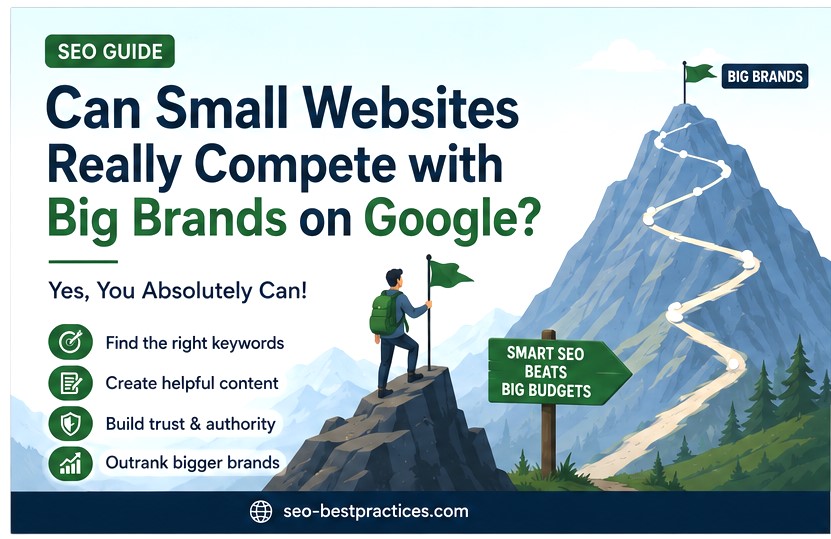
Can Small Websites Compete with Big Brands on Google?
The short answer is yes.
Many new website owners believe that Google only ranks large companies with big marketing budgets. While well-known brands often have an advantage, that doesn’t mean smaller websites can’t succeed.
In fact, many small websites rank ahead of larger competitors by focusing on helpful, well-written content that answers specific questions.
Why do big brands rank so well?
Large companies often have:
- Thousands of pages
- Strong domain authority
- Large backlink profiles
- Dedicated SEO teams
- Years of publishing experience
This gives them an advantage for broad, highly competitive keywords.
For example, trying to rank for a keyword like “SEO” is extremely difficult.
But that doesn’t mean all opportunities are gone.
Small websites have a different advantage
Instead of competing for the biggest keywords, focus on specific questions that people are actually searching for.
Examples include:
- How long does SEO take?
- Can I do SEO myself?
- What is keyword research?
- Does SEO still work in 2026?
- How often should I update my website?
These are known as long-tail keywords, and they are often easier to rank for.
Create helpful content
Google’s goal is simple: show the page that best answers the user’s question.
You don’t need to write the longest article—you need to write the most useful one.
Use:
- Clear headings
- Short paragraphs
- Practical examples
- Simple language
- Internal links to related articles
Build authority over time
One good article helps.
Ten related articles help much more.
When your articles connect naturally to one another, Google begins to understand that your website has expertise in that topic.
Be patient
SEO isn’t a race.
Every article you publish becomes another opportunity for someone to discover your website.
Many successful websites started with only a handful of pages.
Final Thoughts
Small websites absolutely can compete with big brands.
You may not outrank them for every keyword, but you can build consistent traffic by answering real questions, publishing regularly, and creating genuinely helpful content.
Every article you publish is another step toward building authority and trust.
Ready to Take the Next Step?
If you found this guide helpful, explore our collection of beginner-friendly SEO workbooks, templates, and free resources designed to help you improve your website one step at a time.
Start Here
📘 Free SEO Quick Start Guide
A practical introduction to SEO with simple, actionable tips.
📗 First-Time SEO Starter Kit
Perfect if you’re new to SEO and want a step-by-step roadmap.
📙 SEO Audit Workbook
Learn how to identify and fix common SEO issues affecting your website.
📒 Keyword Research Template
Find the keywords your audience is actually searching for.
📋 On-Page SEO Checklist
A simple checklist to optimize every page before you publish.
👉 Visit the SEO Shop:
https://seo-bestpractices.com/shop/