Introduction
SEO Audit Checklist 2026
SEO audit checklist comes in because most websites don’t struggle with SEO because of a lack of effort. They struggle because they don’t know what’s actually broken.
An SEO audit is not just a checklist—it’s a diagnostic system that helps you identify what’s holding your rankings back and where to focus your effort.
This guide walks you through a clear, practical SEO audit process for 2026, so you can identify issues and fix them systematically.
1. What is an SEO Audit (and Why It Matters)
An SEO audit 2026 checklist is a structured review of your website’s ability to:
- Rank on search engines
- Attract traffic
- Deliver a good user experience
Most importantly, it helps you answer:
“Why am I not ranking—and what should I fix first?”
Without an audit, SEO becomes guesswork.
With an audit, it becomes focused execution.
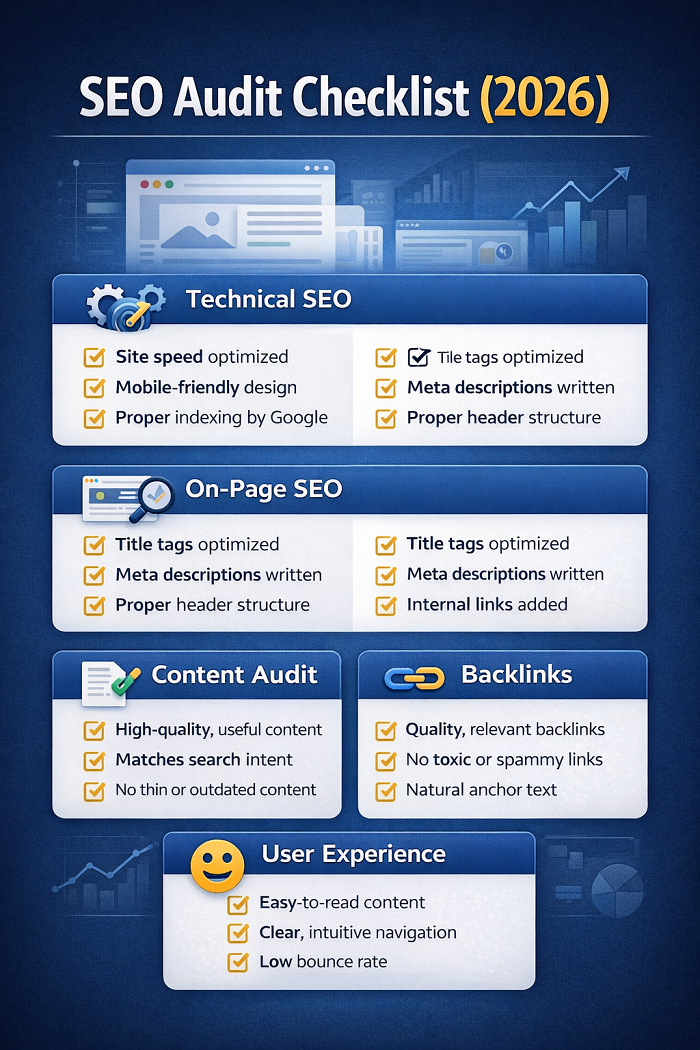
2. Quick SEO Audit Checklist 2026 Overview (Start Here)
Before going deep, here’s what a complete audit covers:
- Technical SEO
- On-page SEO
- Content quality
- Backlinks
- User experience
Don’t try to fix everything at once.
Start with what impacts rankings the most.
3. Technical SEO Audit
If search engines can’t properly access your site, nothing else matters.
Check the basics:
- Site speed
- Pages should load quickly
- Mobile-friendliness
- Most users are on mobile
- Indexing
- Are your pages appearing in Google?
- Broken links
- Remove or fix them
Technical SEO is not about perfection—it’s about removing friction
On-Page SEO Audit
This ensures your pages are clearly understood by search engines.
Review:
- Title tags (clear + keyword aligned)
- Meta descriptions (encourage clicks)
- Header structure (H1, H2, H3)
- Internal linking
What to watch for:
- Missing structure
- Overuse of keywords
- Poor readability
Good on-page SEO improves both rankings and usability
5. Content Audit
This is where most SEO wins come from.
Evaluate your content:
- Is it useful and complete?
- Does it match search intent?
- Is it outdated?
- Is it too thin?
Action steps:
- Improve high-potential pages
- Update outdated content
- Remove or merge weak pages
Often, updating existing content beats creating new content
6. Backlink Audit
Backlinks signal authority—but only if they’re high quality.
Check:
- Are your links coming from relevant sites?
- Do you have spammy or low-quality links?
- Is your anchor text natural?
You don’t need many links—you need the right ones
7. User Experience (UX) Audit
This is where modern SEO is shifting.
If users don’t engage, rankings drop.
Evaluate:
- Is your content easy to read?
- Is navigation clear?
- Do users stay on your page?
SEO is no longer just about traffic—it’s about engagement
8. SEO Audit Tools (Keep It Simple)
You don’t need dozens of tools.
Start with:
- Google Search Console → performance + indexing
- Google Analytics → user behavior
- One SEO tool (optional) → deeper insights
Tools support decisions—but don’t replace thinking
9. Your Action Plan (Most Important Section)
Don’t leave the audit as information—turn it into action.
Step-by-step:
- Fix technical issues
- Improve high-potential pages
- Strengthen content quality
- Build relevant backlinks
Focus on impact, not volume
10. FAQs
How often should I do an SEO audit?
Every 3–6 months, or when performance drops.
Can I do an SEO audit myself?
Yes. Most issues can be identified with basic tools and structured review.
What should I fix first?
Start with technical issues, then move to content improvements.
Conclusion
SEO doesn’t fail because of a lack of tactics.
It fails because of a lack of clarity.
An SEO audit gives you that clarity.
Instead of doing more, you start doing what actually matters.
And that’s what drives results.
Not sure what is holding your website back?
Before making random SEO changes, start with a simple check.
The First-Time SEO Starter Kit helps you review your website basics, understand your audience, choose keywords, and improve one page at a time.